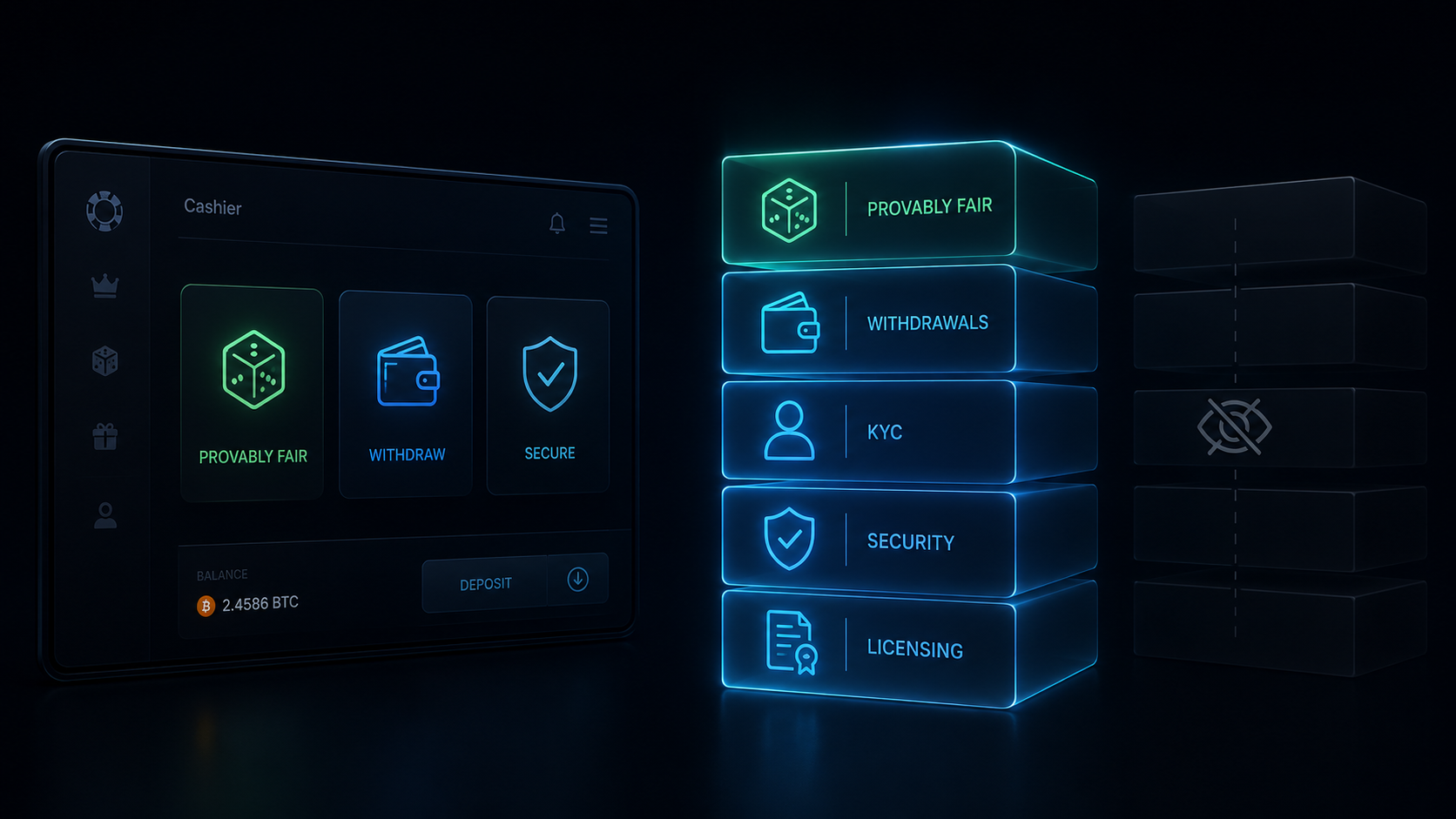
Every console generation gets sold on the same three words: faster, smarter, more immersive. Crypto casinos have been running the exact same playbook for a few years now, except the "smarter" part usually just means a chatbot that can spell RTP correctly. Underneath the marketing there's an actual tech stack running these platforms, and whether that stack is built to protect a player or built to protect the house's margin is the entire ballgame.
Anyone who's spent time reviewing gaming hardware knows the difference between a spec sheet and a real benchmark. Crypto casinos have the exact same gap. The spec sheet says "provably fair," "instant withdrawals," "bank-grade security." The benchmark is what actually happens when you deposit real money and try to take it back out.
Provably Fair Is Real Tech, When It's Actually Implemented
This is the part that gets buried under marketing copy the most. Provably fair isn't a vibe, it's a cryptographic mechanism. A properly built system gives you a hashed server seed before the round starts, lets you set your own client seed, tracks the nonce for every bet, and lets you verify after the fact that the outcome wasn't manipulated. That's real, checkable math, the same category of trust mechanism you'd expect from anything claiming to be tamper-proof.
The catch is that provably fair almost always applies to originals, dice, crash, mines, Plinko, coin flip, the kind of game a casino builds in-house on its own contract. The second you move to third-party slots or live dealer tables, that verification layer disappears entirely and you're back to trusting RTP disclosures and provider audits instead of cryptographic proof. A site that lets that distinction blur in its marketing, implying the whole lobby is provably fair when only the originals are, is doing something closer to a spec sheet lie than an honest feature list.
Withdrawal Speed Is a Software Problem, Not a Marketing Slogan
"Instant withdrawals" gets slapped on more casino homepages than "next-gen" gets slapped on graphics cards. The reality is that withdrawal speed is a function of the actual back-end architecture: how the casino's risk engine flags transactions, whether the crypto payout is automated or routed through manual approval, and how the network itself confirms the transaction once it's sent.
Bitcoin transfers can take a while when the network is congested, no casino controls that. But a well-built platform automates its own side of the process so a normal-sized withdrawal doesn't sit in a queue for a human to eyeball. A casino claiming instant payouts while manually reviewing every cashout above a modest threshold isn't lying exactly, it's just describing the best case and hoping you don't ask about the average case.
KYC and Verification Are Where the Real Engineering Lives
Here's the part most gaming-focused reviews skip entirely, because it's not fun to write about. The verification system behind a crypto casino is a genuinely complex piece of software, tying together source-of-funds checks, restricted-country logic, fraud flagging, and document review. Some platforms build this well: signup requirements are clear, withdrawal-stage checks are disclosed upfront, and the fraud detection doesn't treat every winning session like a crime in progress. Others build it as an afterthought, bolted onto the cashier with vague terms that give the operator total discretion to freeze an account and call it a "security review" with no defined end date.
That gap between a well-engineered verification system and a discretionary black box is exactly the kind of thing a serious review has to test with real deposits, not just read off a terms page. This is where CoinBettors built its whole review process, treating the technical side of a casino, licensing verification, cashier rules, payout reliability, RTP transparency, the same way a hardware reviewer treats a benchmark run. Real deposits, real withdrawal requests, real support tickets, and a documented scoring system across five weighted categories instead of a vibes-based star rating. If a platform's real behavior doesn't match its own claims, that shows up in the score. You can check out how the ratings actually break down at CoinBettors, which runs exactly this kind of testing on the operator side rather than just reading marketing copy back to you.
Licensing Is Infrastructure Too, Even If It Sounds Boring
Nobody gets excited about a licensing footer badge, but it's genuinely part of the technical trust stack. A Curacao license under the newer CGCB framework carries different obligations than a Costa Rica corporate registration wearing a gaming badge it doesn't actually have. Anjouan and Tobique each have their own quirks in enforcement and dispute resolution. None of this shows up in a screenshot of a slick lobby, but it's exactly the layer that determines whether a player has any recourse at all if a casino decides to stall a payout.
The Pattern That Actually Predicts Trouble
If there's one signal worth remembering from testing dozens of these platforms, it's this: a casino that's vague about its own verification triggers is usually vague on purpose. Clear thresholds, published limits, and documented review timelines cost the operator nothing to publish if the system is actually fair. The ones that keep it deliberately foggy are the ones building in room to stall a withdrawal whenever it's convenient, and calling it compliance.
That's really the whole tech story here. A modern crypto casino isn't judged by its game count or its bonus percentage, the same way a gaming PC isn't judged by the sticker on the box. It's judged by what happens under load, when a real player wins real money and tries to walk away with it, and whether the system behind the curtain was built to let that happen cleanly or built to make it as complicated as possible.
About Author